
GPS
Griffith Park Satellites

In the video for “Weather,” a short-and-sweet single that preceded GPS’s debut, Gabriel Giammarco is everywhere at once. With the help of nifty editing full of psychedelic overlays, the song’s lyrics, which ricochet between cities and time-lapse through seasons, make you feel as if you, too, have traveled thousands of miles in 90 seconds.


When GPS released this track, already Giammarco, principal songwriter, multi-instrumentalist, and man behind the moniker, was hinting at a larger theme. “GPS” stands for Global Positioning System, a means of using satellite technology to know “where we are and where we are going anywhere on Earth.1” In Giammarco’s case, the letters stand for “Griffith Park Satellites,” an homage to his hometown and point of reference for his songs.
On his self-titled debut, released July 17 of this year, Giammarco takes this theme of travel several steps further, expanding the range of distance from continental to global, posing a variety of questions that all seem to ask the same thing: can travel—both physical and spiritual—be a means for change?
The album’s opener, “Satellite,” places us at our origin; a carousel-pretty fanfare glimmers like distant city lights. “Break it down,” Giammarco sings, “... Climb a tree on some far shore.” The album starts with an ending, saying goodbye to all that, ushering in the unknown.
“Grass Grows,” the album’s first single, hovers between childhood and maturity, shimmering chords cut with bluesy bends. The speaker is in the present and past simultaneously, once “afraid,” now “blowing smoke.” The song’s structure is pleasantly repetitive, like finding yourself humming the same refrain over and over. The speaker asks, “Turn away / Did ya cast a shadow?” In the sunny soundscape, such moments feel pointed, wisdom that only comes with hindsight. On “Passport,” a deep bed of crackling snares, glassy pianos, and woeful vocals warp and bend the singer’s sense of objectivity: “Knew his name / Now you ain’t sure.” The token of travel in the song’s title imbues the track with worldly detachment, like staring out a plane window at circuit board cities below.
But on “Pocket Change,” a bright and shaggy tempo shift, Giammarco throws on a machine-washed T-shirt and strolls into a chalk painting on the sidewalk. The song’s animated images, easy-to-absorb structure of a campfire singalong, and a Looney Tunes Wurlitzer line give Giammarco the fun and freedom to be a kid again.

Following the raucous triumph of “Pocket Change,” the tracklist turns off the main road and down a quiet back alleyway. “Drunken Sailor,” “Focus On You,” and “Moving Man” offer softer sides to the album, catchy nonetheless. Giammarco’s influences—the Beach Boys, the Beatles, Wilco—are on full display, yet these songs have a diaristic, obliquely personal quality: pages from a journal that have washed ashore.
This contemplative tone is especially dialed in on “Moving Man,” the last single GPS released. The title returns to one of the album’s main threads: moving. But by shaping the lyrics with anaphora and rhetorical rhymes, the motion feels like something the speaker is taking a break from, as we find them catching their breath on a park bench. But about halfway through, a crunchy electric guitar and double-tracked vocals enter the mix, and suddenly, the foot is back on the accelerator. Little shifts like this, across all the tracks, make the mixing and instrumentation dynamic and sophisticated without ever being too distracting or flashy.

“Travel Town,” a quiet yet forceful track on the album’s back half, ties all the album’s themes of travel together, propelling the listener forward. Travel Town, which the song may or may not be a reference to, is a novelty railroad at the heart of Griffith Park. It’s a whimsical place to go on a pretend train ride, a matte painting getaway that deposits you right back where you started. The lyrics carry the baton of wishing to do things over but knowing the past will only repeat itself; the song is rich with melodies, horns, and a layered structure that runs in a circle. It is also one of the parts on the album where Giammarco lets himself rock out, unsheathing a bristling lead line during the outro, underscoring his words with ridicule and rage. Ending the song on this note feels like we are hearing the speaker break free, a changing of states, a vow not to ride the loop of Travel Town anymore.
In October of 2023, I visited Giammarco in Brooklyn, where he was living and writing songs, some of which ended up on GPS. I sat in a living room filled with guitars, keyboards, and cables while a revolving cast of local musicians came to rehearse recent inventions like “Read My Paper” and “Grass Grows.” The songs changed a bit each pass, substituting a chord or altering a part, but for the most part they felt solid, already quite full and developed. I remember thinking that if Giammarco wanted, he could press record and release them, as is. But seeing the songs transform and patinate with time evinces the craft involved, a razor’s edge between being a perfectionist and being at peace with what something already is.
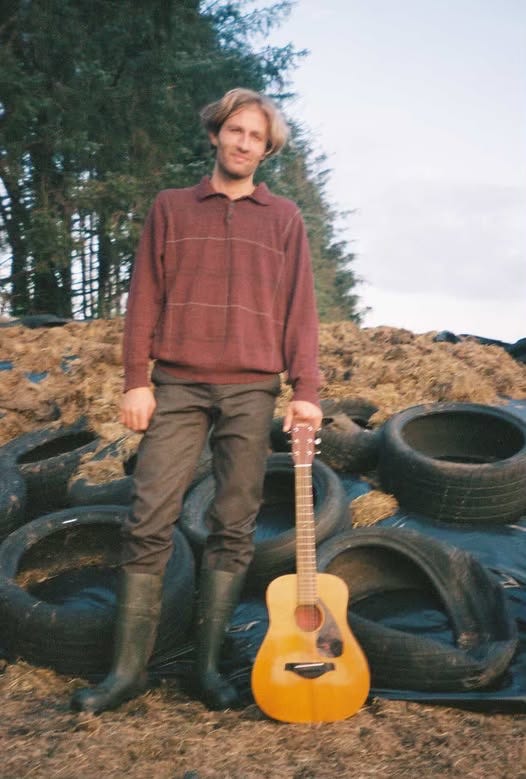
Listening to GPS now, I hear the distances traveled in more ways than one: an artist at their outset who has just completed something significant. That in every ending lies the beginning of something new. In the last moments of the album’s final track, “Lightswitch,” there are pleasing sounds of bells, horns, and whistles, recalling a language used to communicate between train conductors. The sounds are ambiguous, yet inviting. Is it the train pulling into its station, or leaving it?
Where has “Conversations with Artists” been my whole life?! 😍